Introduction
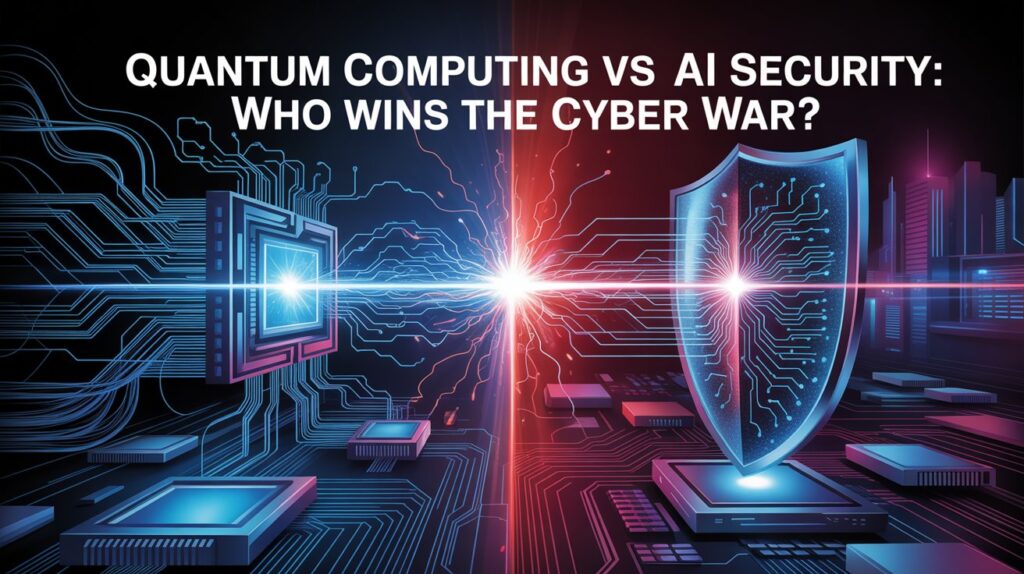
The digital battlefield is heating up, and the two biggest forces at play are Quantum Computing and AI Security. By 2025, cyberattacks are predicted to cost the world more than $10 trillion annually, and the question is no longer if but how we can protect ourselves. With Quantum Computing vs AI Security becoming the defining duel of this era, everyone is asking: who will win the cyber war?
On one side, Quantum Computing promises to crack encryption codes in seconds that would take traditional supercomputers centuries. On the other, AI Security fights back with adaptive, self-learning algorithms that detect threats in real-time. This isn’t science fiction—it’s the future of cybersecurity.
What is Quantum Computing?
Quantum Computing in Simple Terms
Unlike classical computers that rely on bits (0s and 1s), Quantum Computing uses qubits. Qubits can exist as both 0 and 1 simultaneously (thanks to quantum superposition). This allows quantum machines to perform massive computations in parallel.
Why It Matters for Cybersecurity
- Breaking Encryption: Quantum algorithms like Shor’s Algorithm can crack RSA encryption (the backbone of online security) in minutes.
- Unstoppable Power: Problems once considered impossible—such as factoring huge prime numbers—become trivial.
- Game-Changing Speed: Quantum computers can test millions of encryption keys almost instantly.
If cybercriminals weaponize Quantum Computing, today’s security measures may collapse overnight.
What is AI Security?
AI Security in Simple Terms
AI Security leverages artificial intelligence and machine learning to predict, detect, and neutralize cyber threats before they cause damage. It doesn’t just react—it learns and adapts in real-time.
Why It Matters in the Cyber War
- Behavioral Analytics: AI identifies unusual activity, such as suspicious logins or abnormal data transfers.
- Threat Prediction: AI models predict attack vectors before hackers strike.
- Automation: AI responds in milliseconds—much faster than any human team.
With AI Security, defenders gain a constantly evolving shield that adjusts to hackers’ tactics.
Quantum Computing vs AI Security: The Battle Lines
The Offensive Power of Quantum Computing
- Hackers using Quantum Computing could instantly crack traditional encryption.
- State-sponsored cyber warfare may harness quantum systems for espionage.
- Passwords, banking data, and confidential communications would become vulnerable.
The Defensive Power of AI Security
- AI Security can detect anomalies from quantum-powered attacks.
- Machine learning models create quantum-proof strategies, constantly adapting encryption techniques.
- AI-driven automation reduces human error, one of the biggest cybersecurity weaknesses.
In the clash of Quantum Computing vs AI Security, one attacks, the other defends. It’s a high-stakes arms race.
Real-World Examples: Quantum Computing vs AI Security
Tech Giants Preparing for the Cyber War
- Google & IBM: Investing billions into quantum research.
- Microsoft & Darktrace: Expanding AI Security to counter future quantum threats.
- Government Initiatives: Countries like China and the U.S. are racing to build both quantum power and AI defenses.
Emerging Solutions
- Post-Quantum Cryptography (PQC): Encryption designed to withstand quantum attacks.
- AI-Powered Anomaly Detection: Identifies even quantum-driven intrusions.
Advantages of Quantum Computing vs AI Security
Quantum Computing Advantages
- Unmatched computing speed.
- Ability to break existing encryption.
- Revolutionary scientific applications (beyond hacking).
AI Security Advantages
- Real-time detection and response.
- Constantly evolving defense mechanisms.
- Scalable protection for businesses and governments.
Challenges in the Cyber War
The Risks of Quantum Computing
- Cybercrime Acceleration: Hackers with access could wreak global havoc.
- Digital Collapse: Traditional security could fail overnight.
The Risks of AI Security
- False Positives: AI may block legitimate users.
- Bias & Exploits: If trained poorly, AI can be tricked.
- Arms Race Costs: Keeping AI defenses updated is expensive.
Future Outlook: Who Wins the Cyber War?
Quantum Computing’s Future Role
By the early 2030s, quantum machines may reach the point of breaking standard encryption instantly. This could spell disaster without new defenses.
AI Security’s Future Role
AI Security will remain humanity’s best defense—building quantum-proof encryption and creating adaptive responses. While quantum attackers grow stronger, AI defenders grow smarter.
The Likely Outcome
In the battle of Quantum Computing vs AI Security, the winner may not be one side but a balance of both. Quantum computing will push innovation, while AI security will ensure resilience.
Internal Links for BrainScrolls Readers
- 📘 AI-Powered Passwords: Will Traditional Logins Die by 2026? – Explore how AI is redefining logins.
- 📘 Best AI Tools for Students in 2025 – Discover AI tools revolutionizing education.
- 📖 The Prompt Engineer’s Vault – Unlock 200+ powerful ChatGPT prompts.
External Sources for Authority Linking
- IBM Quantum Computing – IBM’s advances in quantum research.
- Darktrace AI Security – Leading AI-driven cybersecurity solutions.
- NIST Post-Quantum Cryptography – U.S. efforts to build quantum-resistant encryption.
Conclusion
The cyber war of the future isn’t fought with soldiers, but with algorithms and qubits. Quantum Computing vs AI Security defines the next digital battlefield. While quantum machines threaten to dismantle encryption, AI-driven defenses rise to counter these attacks.
The ultimate question remains: who wins? The answer may be that the cyber war never truly ends—only evolves. One thing is certain: businesses, governments, and individuals must prepare now, or risk being left defenseless.
Final Thought
Want to dive deeper into the future of AI and cybersecurity? Explore more insights on BrainScrolls.com, where we decode tomorrow’s technology today.