Introduction
Running a small business today is exciting—but it’s also riskier than ever. While technology helps companies grow faster, it also creates new entry points for cybercriminals. And here’s the shocking part: nearly 43% of all cyberattacks target small businesses.
Why? Because hackers know smaller companies often don’t have big budgets for cybersecurity. Many believe they’re “too small to matter,” but in reality, small businesses are goldmines for sensitive customer data, credit card details, and financial information.
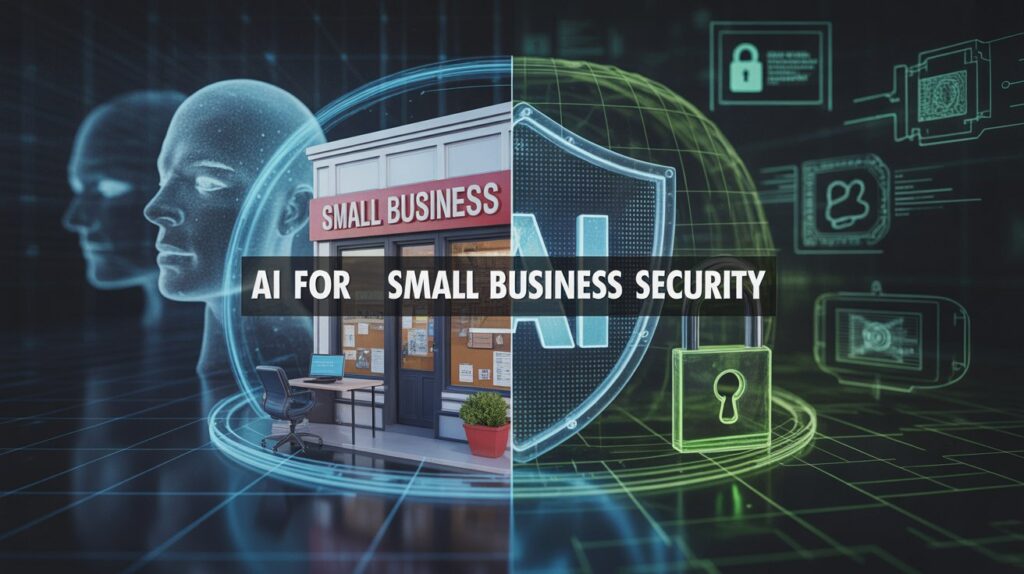
This is where AI for small business security comes in. Artificial Intelligence is no longer just for tech giants—it’s affordable, easy to use, and designed to protect companies of all sizes. Think of it as your digital bodyguard, monitoring systems 24/7, spotting suspicious behavior, and stopping hackers before damage is done.
In this beginner’s guide, you’ll learn what AI for small business security is, how it works, which tools to use, and why it’s the future of protecting your company.
What is AI for Small Business Security?
AI for small business security means using artificial intelligence and machine learning to protect digital systems, customer data, and financial information.
Unlike traditional security, which waits for known threats, AI learns as it goes. It identifies unusual behavior, analyzes patterns, and stops suspicious activity—even when the threat is new or unknown.
For small business owners, that means protection without needing a massive IT team. AI becomes your around-the-clock watchdog, constantly adapting to new cyber risks.
Why Small Businesses Are Easy Targets
Limited Budgets, Big Risks
Most small businesses can’t afford full-time security teams. Hackers know this, making them easy prey.
Outdated Security
Relying only on antivirus or basic firewalls doesn’t cut it in 2025. AI-powered phishing emails and deepfake scams bypass these defenses easily.
Human Error
Employees accidentally click bad links or reuse weak passwords. AI reduces these risks by automatically flagging suspicious activity before it causes harm.
How AI Protects Small Businesses
Real-Time Threat Detection
AI monitors networks, logins, and emails nonstop. If something unusual happens—like 10,000 login attempts in an hour—it shuts it down immediately.
Behavioral Analytics
AI learns what “normal” looks like for your business. For example, if Sarah always logs in from New York at 9 a.m., and suddenly there’s an attempt from another country at 3 a.m., AI blocks it.
Automated Response
When a threat is detected, AI reacts in seconds. It can quarantine suspicious emails, lock hacked accounts, or block fraudulent payments instantly—without waiting for human approval.
Key Benefits of AI for Small Business Security
- Affordable Protection – AI tools cost far less than hiring a cybersecurity team.
- 24/7 Monitoring – Unlike humans, AI never sleeps.
- Fraud Prevention – Especially useful for e-commerce and online payments.
- Scalable Solutions – AI grows with your business, whether you have 5 or 500 employees.
Affordable AI Tools for Small Business Security
- CrowdStrike Falcon – AI-powered endpoint protection.
- Sophos Intercept X – Budget-friendly for small companies.
- Proofpoint Essentials – Stops phishing and malicious emails.
- Duo Security (Cisco) – AI-based multi-factor authentication.
- Bitdefender GravityZone – Cost-effective all-in-one solution.
- Darktrace – Advanced AI monitoring designed for small businesses.
The Dark Side: Hackers Use AI Too
It’s important to remember that AI isn’t just for defense. Hackers use AI to:
- Write realistic phishing messages.
- Create deepfake audio or video for scams.
- Find software vulnerabilities faster than humans.
That’s why small businesses must adopt AI for security—only AI can fight back against AI-driven attacks.
How to Get Started with AI Security
- Audit Your Systems – Use free AI scanners to find vulnerabilities.
- Start with Email Protection – Since phishing is the #1 attack, secure your inbox first.
- Enable Multi-Factor Authentication (MFA) – AI-enhanced MFA adds strong protection.
- Train Your Staff – AI-based phishing simulations teach employees to spot attacks.
- Automate Backups – AI-driven recovery ensures business continuity after an attack.
The Future of AI for Small Business Security
By 2026, experts predict:
- Passwords will be replaced by AI-driven biometric logins.
- AI will detect and stop cyberattacks before they even begin.
- Compliance reporting will be fully automated, saving small businesses time and stress.
Small businesses that adopt AI security now won’t just avoid cyber disasters—they’ll also build trust with customers who value safety and privacy.
In today’s digital era, securing your business is just as important as growing it. For deeper insights, you can explore guides on best AI tools for students in 2025 to understand how AI is shaping productivity, or learn from global leaders like IBM AI Security and Microsoft Defender. If you’re running an online store, check out Shopify’s AI security tools for safe transactions. By combining practical steps with trusted platforms, your small business can confidently navigate today’s cyber challenges.
Conclusion
Cybercrime is no longer a “big business problem.” Hackers target small businesses precisely because they think they’re unprepared. But with AI for small business security, even the smallest company can defend itself with tools once reserved for corporations.
AI delivers 24/7 protection, fraud detection, real-time threat monitoring, and smarter defense—all at a cost that fits small business budgets.
The question isn’t if you should use AI security. The question is how fast can you start? Because in today’s digital world, AI for small business security may be the smartest investment you’ll ever make.